SSI is the most quoted and least understood number on LinkedIn. People trade it like a club badge, then wonder why a rising score never turned into pipeline. Here's the honest version. It's what the Social Selling Index actually measures, how the score gets built, and why the four behaviors behind it are the exact behaviors the LinkedIn algorithm rewards.
I spent three years inside LinkedIn, much of it on Sales Navigator and the team that shipped the Social Selling Index. So this comes straight from the model, translated into what I'd actually do on Monday.
TL;DR - The Five Things That Matter
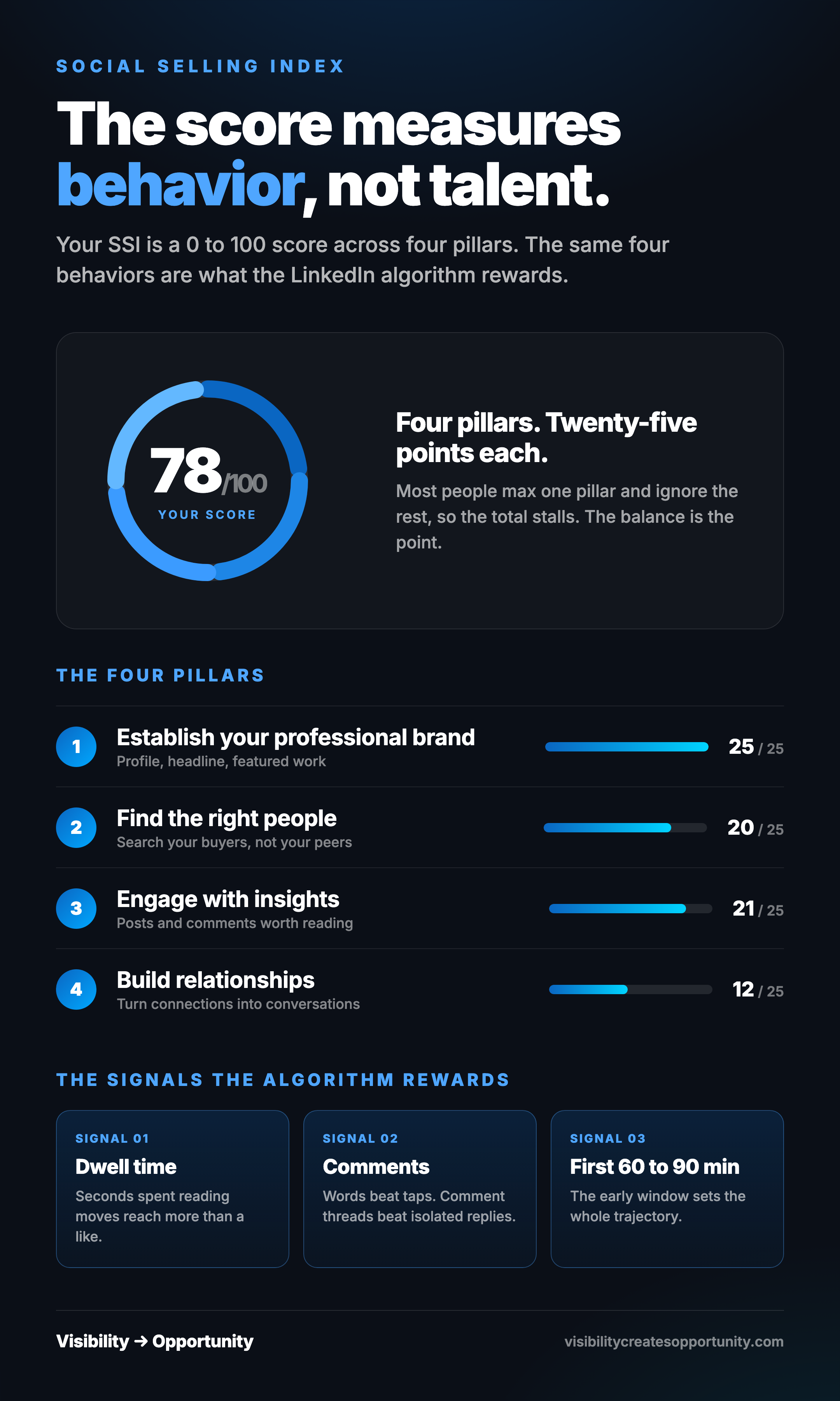
1. SSI is a 0 to 100 score across four pillars, 25 points each, refreshed daily.
2. The pillars are: establish your professional brand, find the right people, engage with insights, build relationships.
3. The LinkedIn algorithm rewards the same behaviors SSI measures: dwell time, comments, and the first 60 to 90 minutes.
4. SSI is a leading indicator. Pipeline is the outcome. Never confuse the two.
5. You raise SSI by behaving like a person worth following, not by gaming a checklist.
What is the Social Selling Index?
The Social Selling Index is a proprietary score LinkedIn calculates for every member, from 0 to 100, refreshed every day. It's private. Nobody sees your number but you. It doesn't measure how clever your posts are. It measures whether you behave like someone who builds a network on purpose.
The score is the sum of four pillars, each worth 25 points. That symmetry matters. It tells you exactly where the weight sits. Most people max out one pillar and ignore the other three. That's why their score plateaus in the middle of the range.
professional brand
people
insights
relationships
Establish your professional brand is the profile pillar: whether your headline, summary, and featured work make your value legible to a stranger. Find the right people is the search pillar: whether you use LinkedIn's tools to locate your buyers instead of waiting for them to appear. Engage with insights is the content pillar: whether your posts and comments add something worth reading. Build relationships is the network pillar: whether you turn connections into real conversations.
What counts as a good SSI score?
There's no universal passing grade, and anyone who quotes you one is guessing. What's true is that the distribution is wide. Most active professionals cluster in the middle of the range, and a small group sustains the top band because they behave like creators rather than spectators. Wherever you land, two comparisons matter more than any global number. Your score against your own 90-day baseline, and your score against the specific people in your sector who are actually generating pipeline.
I treat the number as a scorecard. A 60 that comes from real relationships beats an 80 that comes from commenting "Great post" forty times a day, every time. The algorithm can be fooled for a week. A buyer can't be fooled about whether you're worth their attention.
"The SSI measures behavior, not talent. Change the behavior and the score follows. Ignore the behavior and the score means nothing."
How the SSI maps to the LinkedIn algorithm
This is the part I almost never see explained. The SSI and the LinkedIn algorithm point at the same truth. I learned this inside LinkedIn, and I've confirmed it across visibility programs since.
The feed is a cascade, not one ranking
There's no single algorithm. There's a cascade of ranking models, and every post survives or dies at each layer. First the model decides whether your post is safe and relevant enough to test. Then a smaller model decides who should see it. Then reach either compounds or dies. Understanding that cascade is the whole game, because your one job is surviving each handoff.
Dwell time is the signal you can't fake
The quiet metric is seconds spent reading. A post that holds attention for eight seconds beats a post that collects a dozen reflexive likes in the same span. That's why a short, punchy hook followed by a genuinely useful idea outperforms a clever one-liner every time. The model's trying to predict who'll stop and read. Give it a reason.
Comments carry more weight than likes
A comment's a decision to spend words. A like's a twitch. The feed weights comments far more heavily than likes, and a comment thread that continues carries more than isolated replies. In the programs I run, comment-first engagement produced roughly $340K in attributed pipeline over six months. I've watched it happen with founders who barely post. Call that what it is: a network responding to a person who shows up in their comments before asking for their time. That's what pipeline looks like.
The first 60 to 90 minutes
The opening window sets the trajectory. If the people who see your post early engage, the feed widens the test. If they scroll past, reach flatlines. You control that window completely, which is why posting when your own network is awake beats posting at some globally optimal hour you read about somewhere. Show up for the first hour and reply to every comment.
Formats, links, and hashtags
Native formats win. A text post holds dwell time, an image post earns the stop, and a document post can carry depth. Outbound links carry a reach tax, so the winning move's to tell the story in the post and drop the link in the first comment, not the body. Hashtags do very little in 2026, and stacking them can quietly cost you reach. I go deeper, in full, in the companion piece on how the LinkedIn algorithm works.
How to raise your SSI (without gaming it)
I'd start with your weakest pillar, not the one you enjoy. For most people that's the relationship pillar, because brand and content are fun and outreach isn't. Here's the order I'd run it in.
Fix the foundation (brand pillar)
Rewrite your headline around the outcome you deliver, not your title. Make the top of your profile answer one question a buyer has in the first three seconds. One hour, once, done.
Engage with intent (insights pillar)
Comment on five posts from your ICP every day before you post your own. Add a specific point, a data point, or a disagreement. It's the fastest lever on both your SSI and your reach.
Find the right people (search pillar)
Use saved searches for your buyers, not your peers. Build a list of 50 real people a week. The search pillar rewards a system, not an afternoon of scrolling.
Build relationships (relationship pillar)
Send two or three specific, no-ask messages a day. Reference something real. Ask nothing in the first touch. This pillar moves slowest and lifts your total the most.
Frequently asked questions
What is the Social Selling Index?
It's a proprietary score LinkedIn calculates for every member, from 0 to 100, refreshed daily. It measures four behaviors: establishing your professional brand, finding the right people, engaging with insights, and building relationships. It's private, so only you see your number.
What is a good Social Selling Index score?
There's no universal passing grade. Most active professionals sit in the middle of the range, and sustained scores in the top band signal someone who behaves like a creator. Compare your score against your own 90-day baseline, and against the people in your sector who generate pipeline.
How is the SSI calculated?
The SSI is the sum of four pillars worth 25 points each, for a maximum of 100. Each pillar rewards a specific set of behaviors, such as profile completeness, engagement with your network, and relationship-building actions. The score recalculates daily.
Does the Social Selling Index affect the LinkedIn algorithm?
The SSI measures the same behaviors the LinkedIn feed rewards: dwell time, comments, and early engagement. Raise those behaviors and you raise both your score and your reach.
How do I improve my SSI quickly?
Improve your lowest pillar first. Most people are strong on brand and weak on relationships. Spend 30 days commenting on your ICP's posts before you post your own, and send two or three specific, no-ask messages a day. The relationship pillar moves fastest and lifts your total the most.
Want a visibility program built on behavior, not vanity?
The Executive Visibility Program turns the SSI behaviors into a weekly system: the posts, the comment strategy, and the relationship cadence that produces pipeline, not just a number.
Book a Strategy Call ->For the full method behind the relationship pillar, read the Social Selling OS playbook. For the founder version, start with For Founders.