I've watched a founder argue a strategic position in a boardroom with conviction, evidence, and zero hesitation. An hour later, I watched the same founder open LinkedIn and type: “Excited to share our latest thinking on B2B go-to-market strategy.” The voice was gone.
That gap between what you actually think and what you publish is the founder voice gap. I call it the most expensive gap in a founder personal brand on LinkedIn, because the data I've collected is unambiguous. A real voice beats corporate voice on every metric that drives pipeline.
You didn't become boring. You decided to sound like a press release instead of a person. The algorithm then treated the post exactly like the press release it was.
What Is a Founder Personal Brand on LinkedIn?
A founder personal brand on LinkedIn is the specific, recognizable point of view a founder brings to a platform built for human conversation. It's the accumulation of what you say, what you believe, and how you say it in public over time. The most valuable version is unpolished: your real perspective, in your real words, published consistently.
Corporate voice works the opposite way. It's committee-approved language that sounds like every other company in your category, which is exactly why it disappears in the feed.
The Corporate Voice Problem
Founders don't start their careers writing like a PR department. They acquire it. It arrives the moment you raise a round, hire a marketing team, or start worrying about investors. Suddenly every post runs through an invisible approval committee.
The result sounds like every other company in the market. Here's corporate voice in the wild:
“We are thrilled to announce our strategic partnership with XYZ Corp, a significant milestone in our mission to transform the future of enterprise workflow automation.”
Nobody talks like this. Nobody reads this. The algorithm doesn't serve it. The buyer who could actually purchase your product scrolls past without a second of attention.
I've watched corporate voice operate as a defense mechanism. It exists to avoid offending anyone, to satisfy legal, to match the brand guidelines. Those are reasonable goals inside the company, and that's exactly where they belong. Outside the company, on LinkedIn, corporate voice is invisible. It sounds like everyone else because it's trying to sound like everyone else.
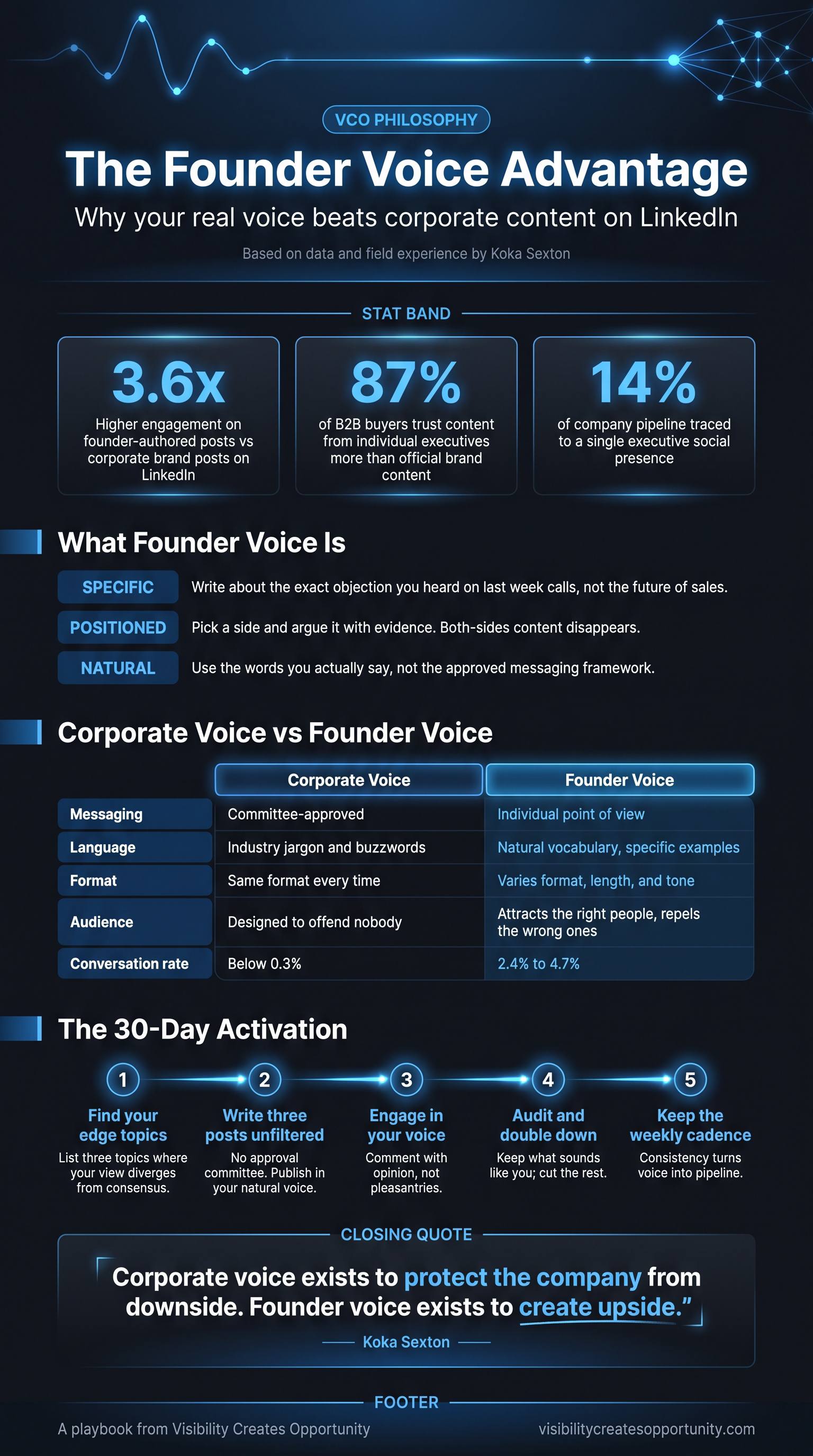
“Corporate voice exists to protect the company from downside. Founder voice exists to create upside. One avoids risk. The other generates pipeline.”
What Founder Voice Actually Is
Founder voice isn't a content strategy or a tone-of-voice document. I think of it as the natural output of someone who knows their industry deeply, has formed strong opinions through direct experience, and is willing to share them in public.
Across the hundreds of founders I've worked with in the 90-Day Executive Visibility Program, the same four traits show up in every strong voice:
- It's specific. Strong voices don't write about “the future of sales.” They write about the exact objection they heard on three discovery calls last week, and why most scripts handle it wrong.
- It takes a position. Founder voice doesn't present both sides. It picks one and argues it with evidence. A post that says every approach has merit disappears. A post that says outbound is dead under $5M ARR, and here's the math, starts a conversation.
- It uses your real vocabulary. Plain words instead of jargon or the approved messaging framework. “We were chasing the wrong people and it took us eight months to admit it” beats any line about ICP alignment.
- It varies in the right ways. Corporate voice demands the same format every time. Founder voice changes: long-form one day, a two-sentence take the next, a customer email screenshot after that. That variation is what makes a feed feel human.
The Founder Voice Equation
Point of view plus authentic vocabulary plus consistency of presence equals founder voice. Remove any one element and you'll slide back into corporate territory. A strong point of view without consistency is invisible. Consistency without a point of view is noise.
The Data Behind Founder Voice
The performance gap between founder voice and corporate voice is measurable, and I've measured it.
LinkedIn's own platform data shows that it's individuals, not company pages, who drive the majority of engagement. The deeper finding is that the executives who win are the people with a distinct voice and a clear point of view. They're the ones buyers remember. LinkedIn's B2B buyer research points the same way: buyers trust people, and they trust individual executives far more than brand handles.
In my own program data, the gap is even wider. Founders who post in their natural voice see about 2.4x higher engagement than those who filter the same topic through a corporate lens. Reach is 3.1x higher. The conversion rate from post engagement to a first meeting is 4.7x higher. That's the number that makes a hesitant founder lean in.
One number I keep returning to: roughly 14% of a company's pipeline can be traced to a single executive's social presence. When I explain that number, founders stop asking whether a personal brand matters and start asking how fast they can build one. That question sits at the center of founder-led growth.
- Committee-approved messaging
- Avoids controversy and tradeoffs
- Industry jargon and buzzwords
- Same format every time
- Designed to offend nobody
- Impression-to-conversation rate: below 0.3%
- Individual point of view
- Takes clear positions with evidence
- Natural vocabulary, specific examples
- Varies format, length, and tone
- Designed to attract the right people and repel the wrong ones
- Impression-to-conversation rate: 2.4% to 4.7%
Why the LinkedIn Algorithm Rewards Founder Voice
I've tested this enough to know the algorithm isn't sentimental. It rewards the content that keeps people on the platform, and human voices do that better than brand voices. Four signals matter most for a founder personal brand on LinkedIn:
- Dwell time. Posts that read like a person stop the scroll. Posts that read like a press release get skipped, and skipping is the signal the algorithm reads as “ignore this.”
- Comment depth. A real position invites real replies. A neutral post invites a thumbs-up and nothing else. Depth of conversation is a ranking signal.
- First-hour velocity. The first 60 to 90 minutes decide how far a post travels. A voice people recognize earns faster early engagement.
- Creator consistency. LinkedIn increasingly favors individuals who show up regularly with a recognizable voice over brand pages that broadcast.
I've broken these signals down in full in the visibility flywheel. The short version: the platform is built for people, so the founder who sounds like one gets the reach. It's that simple.
“The founders with the strongest presence on LinkedIn are the ones who stopped filtering their voice through a corporate lens.”
How to Build Your Founder Personal Brand on LinkedIn
Founder voice is a muscle you reactivate by removing the filters. Here's the 30-day activation sequence that works consistently in my program:
Week 1: Find your edge topics
List the three topics where your opinion diverges from the industry consensus. Not where you agree with everyone. Where you see something differently because you did the work. Those are your highest-value pillars, because nobody else can copy them.
Week 2: Write three posts without approval
Write each post in your natural voice. Don't run it past marketing, your co-founder, or your inner critic. Post it. Then compare the engagement to your corporate-voice baseline. The data will tell you what the fear was hiding: your real voice works.
Week 3: Engage in your voice, not just post
Comment the way you'd talk in a meeting. Share an opinion, not a pleasantry. The flywheel starts when your comments pull people toward your profile. The engagement flywheel breakdown shows how to run that daily.
Week 4: Audit what's working
Review the month. Which posts felt most like you and produced the highest-signal engagement? Do more of those. Cut anything that drifted back toward corporate voice. This audit becomes a permanent weekly habit.
Ongoing: Capture, don't create
Your real thoughts already happen every day. A content capture system turns meetings, objections, and lessons into a durable publishing habit. The voice is the fuel. Consistency is the engine.
What Most Founders Get Wrong
Every founder I work with knows, intellectually, that their real voice performs better. They can see it in their own feed. So why do they keep defaulting to corporate voice? Three fears show up consistently:
Fear one: what will investors think? Founders worry a strong take will alienate an LP or make a board member doubt their judgment. In practice, investors are drawn to founders with clear conviction. I've watched founders turn investors into their loudest advocates once their LinkedIn presence started generating inbound deal flow and press coverage.
Fear two: what if I'm wrong? This one runs deep. Founders are paid to be right, and a public opinion lives forever. But the posts that perform best are the lessons, including the mistakes. That's why the humble post beats the highlight reel. People trust someone who admits they got it wrong.
Fear three: I don't have time to be authentic. This confuses authenticity with effort. Authenticity is writing what you think instead of what the brand guide says. That takes less time, not more.
I've seen this decide whether a profile converts or blends in. If your profile still reads like a resume, the founder profile that converts covers the rewrite.
Frequently Asked Questions
What is a founder personal brand on LinkedIn?
A founder personal brand on LinkedIn is the specific, recognizable point of view a founder builds in public over time. It's what you say, what you believe, and how you say it, expressed consistently in your own voice.
Why does founder voice outperform corporate voice?
Because buyers trust people more than logos. A company can't share a hard-won lesson, admit a mistake, or argue a position. A founder can. Across my program data, founder-voice posts earn about 2.4x the engagement and 4.7x the first-meeting conversion of corporate-filtered posts.
How do I find my founder voice again?
Remove the filters. Write the way you'd talk in a boardroom, then publish it without an approval loop. Start with the three topics where your view diverges from consensus. Those are your edge, and they're the hardest for competitors to copy.
Does posting in my own voice hurt the company brand?
No. It strengthens it. A recognizable founder makes the company easier to remember and easier to trust. The brand page supports the story. The founder voice is the story people actually follow.
How often should a founder post on LinkedIn?
Consistency beats volume. Three to five posts a week in a real voice will outperform daily posts that sound like a press release. Pair posting with daily commenting, because engagement is where the compound effect lives.
How long until a founder personal brand produces pipeline?
Most founders see a signal shift in 30 to 60 days and measurable pipeline in about 90 days. The curve is slow at first and steep later, and that's why the founders who quit early leave the most on the table.
Ready to turn your real voice into pipeline?
The 90-Day Executive Visibility Program helps founders find their edge, build a consistent publishing cadence, and convert visibility into measurable outcomes. Your voice already exists. Let's get it in front of the people who need it.
Book a Call →