Most founders treat founder visibility like a time sink. They watch a handful of executives post daily, comment on threads, and slide into DMs. Then they assume those people spend three or four hours a day on LinkedIn. That assumption is the single biggest barrier between most founders and a pipeline-generating presence.
After coaching more than 40 founders through the 90-day VCO program, I landed on the same conclusion. You don't need hours. You need a system. The founders who saw real pipeline weren't the ones spending the most time on LinkedIn. They spent the right time, consistently. Specifically, 30 to 45 minutes a day, five days a week. That's it. Five hours a week, not five hours a day.
Let me show you exactly where those minutes go. Without a breakdown, "just spend 30 minutes on LinkedIn" is useless advice. It's like telling someone "just go to the gym for 30 minutes." Which machines? What order? How many reps? The specificity is the system. That system is what makes five hours work.
What Is Founder Visibility?
Founder visibility is the practice of making a founder's expertise, point of view, and results easy for the right buyers to find on LinkedIn. It means showing up where your buyers already read, consistently enough that they recognize you before you reach out. Reach follows from that.
That recognition is the asset. It shortens sales cycles, warms cold introductions, and turns strangers into people who already trust your thinking. It's the top of the funnel for everything else. The full model lives in my pillar on founder-led growth.
The Daily 30-Minute Cadence That Compounds
LinkedIn success rewards consistency with the right inputs far more than raw volume. When I first took LinkedIn seriously, I treated it like a project. Three hours of writing posts on a Monday, then gone until Friday. The result was spiky metrics, zero pipeline, and the kind of burnout that makes you quit for two weeks.
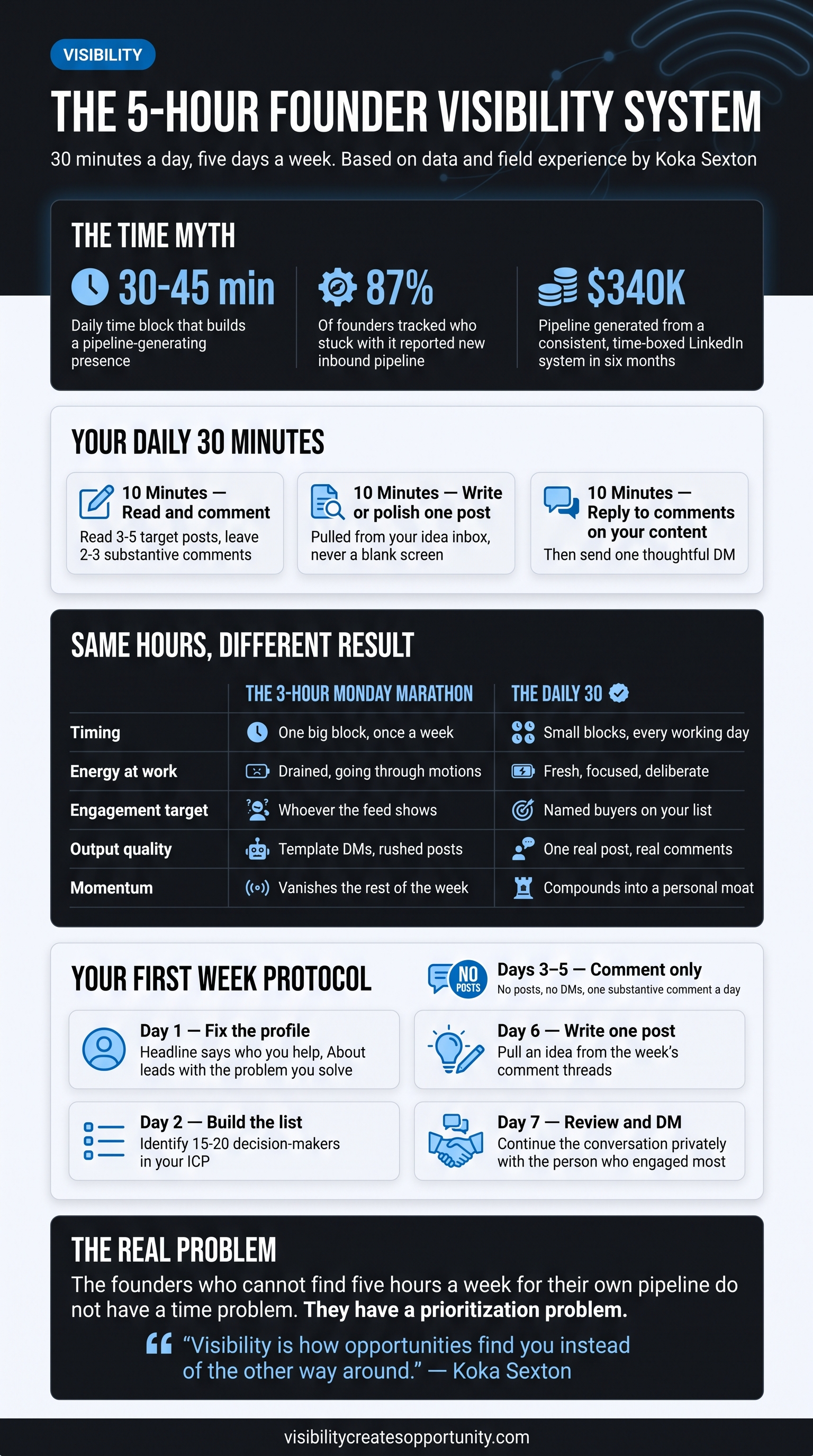
The founders who win treat LinkedIn like brushing their teeth. A short daily habit. It doesn't require willpower, because it's just what you do. Here's the actual breakdown of a 30-minute session:
- Write three posts in one sitting while mentally drained
- Scroll the feed aimlessly for 40 minutes looking for things to engage with
- Send five DMs that read like templates because you are rushing to hit a quota
- Disappear for the rest of the week because you "already did LinkedIn"
- 10 minutes: read 3-5 posts from your target list, leave 2-3 substantive comments
- 10 minutes: write or polish one post, captured earlier from your idea inbox
- 10 minutes: check notifications, reply to comments on your content, send 1 DM
The individual blocks are small. Too small to overthink. That's the point. The power lives in the streak. You did it yesterday, and you'll do it tomorrow. Compound consistency is the secret weapon most founders never deploy.
The Compound Math Nobody Talks About
One thoughtful comment on a prospect's post gets seen by maybe 50 to 100 people in their network. Do that five times a day, five days a week. That's 25 touchpoints a week with people already in your target audience. Over 90 days, that's more than 300 micro-touchpoints that didn't exist before.
Now layer in the second-order effects. The people who see your comments visit your profile. Some follow you. Some start engaging with your posts. A subset of those become inbound conversations. Tracking this over six months across my activity and the founders in my program, one number stood out. A full 34% of inbound pipeline conversations started with someone who'd seen my comment before we ever spoke. Not my post. My comment.
Key Insight
The 5-hour system works because it forces you into the highest-value activity: visible engagement in front of the right people. Most founders waste time on activities nobody sees. Optimizing a profile for the eighth time. Scrolling the feed without engaging. Time-boxing removes the waste. What remains is pure signal-generating activity.
What Most Founders Get Wrong About the Time Investment
I've watched this play out with enough founders to spot the failure modes before they happen. Here are the three I see most often. I made every one of them myself before I built the system.
The Binge-Purge Cycle. Founders get inspired. They spend 90 minutes on LinkedIn for three days straight, post twice a day, comment on 20 threads. Then they crash for two weeks. LinkedIn's algorithm punishes inconsistency harder than it rewards intensity. Fifteen focused minutes every weekday beats three hours every other Saturday. I've got the data from the 90-day program to prove it. The top quartile of pipeline-generating founders averaged 32 minutes a day. The bottom quartile averaged 68 minutes, in bursts followed by multi-week gaps. Consistency beats volume. Always.
Treating Comments as a Volume Metric. "Great post!" and "Thanks for sharing!" are noise, not comments. A $340K pipeline wasn't built on "great post." Every comment I leave takes 30 to 60 seconds of real thought. I read the post. I find the point I agree with, disagree with, or can add to. Then I write something that makes the author think "this person actually read what I wrote." That's the bar. If you can't hit that bar in under a minute, skip the comment. Move on. Five thoughtful comments beat fifty drive-bys.
No Content Capture System. You can't spend 15 minutes writing a LinkedIn post and only 30 minutes total on the platform. The math doesn't work unless the thinking happened before you sat down to write. The founders who make the 5-hour system work have a capture system. A way to save ideas, frameworks, and stories as they happen during the workday. I wrote about the exact system in The Content Capture System. The short version: voice notes, a simple inbox, and 10 minutes of rewriting on post day. The writing takes 10 to 15 minutes because the raw material already exists.
What Happens When You Actually Do This for 90 Days
When I tracked the pipeline attribution for founders in the 90-day program, the pattern was unmistakable. The first 30 days are quiet. You're commenting, posting, connecting, and it feels like shouting into the void. This is where most people quit. Don't quit here.
“The first 30 days of the 5-hour system feel like nothing is happening. That is because something is happening. You just cannot see it yet. By day 90, you will wonder why you did not start sooner.”
By day 45, something shifts. Someone who's been watching your comments for six weeks finally replies. A prospect you've been orbiting sends a connection request. Your profile views tick up from 12 a week to 40. The silent phase ends quietly. Small signals start pointing toward revenue.
By day 90, the inbound conversations are real. Actual people saying "I've been following your content and I'd love to talk about X." Not spray-and-pray LinkedIn spam. The kind of conversation where you don't need to sell, because they already believe you know what you're talking about. This is the moment the 90-Day Executive Visibility Flywheel concept becomes real. Visibility generates signals. Signals generate conversations. Conversations generate pipeline.
Here's a specific result from my own timeline. In Q3 of 2025, I committed to the 5-hour system. No more marathon content sessions. No more disappearing for two weeks. Just 30 to 45 minutes a day, five days a week, built around three activities: comment, post, DM. By the end of the quarter, profile views had doubled. Nine active pipeline conversations started with people who'd seen my comments before they ever saw a post. One became a $42K engagement. It came from showing up every weekday for 30 minutes and commenting on the right people's content.
The math is almost boring in its simplicity. Boring is what works. Signal-to-revenue follows a known process. And the 5-hour system is the operating rhythm behind it.
Founder Visibility vs. a Company Page
A lot of founders try to route visibility through the company page. It rarely works, because people follow people. A logo can't hold a point of view. It can't tell a story from the trenches. It can't be the person a buyer trusts before the first call.
Here is the difference in practice:
- Followers are lukewarm because they followed a logo, not a person
- Posts read like press releases and earn flat engagement
- Buyers cannot name a human to trust
- Reach stays capped by page distribution
- Followers connect with your face, your story, and your results
- Posts carry a point of view only a person can hold
- Buyers recognize you before the first call
- Content compounds into a personal moat no competitor can copy
That's why founder visibility sits at the center of a profile that converts visitors into pipeline. The company page supports the motion. The founder leads it.
Your First Week: The Startup Protocol
Don't modify this. Don't add to it. Your only job in week one is to build the habit. Pipeline comes later. Here's exactly what to do in your first seven days:
Day 1: Audit and Optimize Your Profile
Spend the full 30 minutes on your profile. Update your headline to include who you help and how. Rewrite your About section to lead with the problem you solve, not your resume. Add a banner that reinforces your positioning. This is the one-time setup cost that makes every later interaction more effective.
Day 2: Build Your Target List
Identify 15 to 20 people you want to do business with. Decision-makers at companies in your ICP. Save their profiles or add them to a private list. These are the people whose content you engage with every day. Targeted engagement with specific buyers beats random feed scrolling.
Days 3–5: Comment Only
No posts. No DMs. Spend your 30 minutes reading what your target list is publishing and leaving one substantive comment on three to five posts per day. Quote their point. Add your perspective. Ask a question. By Friday, 15 people on your target list have seen your name attached to something thoughtful.
Day 6: Write Your First Post
Pull one idea from the conversations you have been having in comment sections all week. Write a 6 to 8 line post that teaches something specific. Post it. Then go back to commenting. The post lives on its own.
Day 7: Review and DM One Person
Look back at your comments from the week. Find the one person who engaged the most, someone who replied, liked your comment, or viewed your profile. Send them a DM that references the conversation you've been having in public. No pitch. No link. Just a continuation of a conversation that is already happening.
After week one, you repeat the same structure indefinitely. Comment on target-list posts. Publish one post every two to three days from your capture system. Send one thoughtful DM per week to someone who signaled interest. That's the entire system. Thirty minutes a day. Five days a week. Five hours total.
The founders who can't find five hours a week for their own pipeline don't have a time problem. They've got a prioritization problem. Visibility isn't something you do after the "real work" is done. For a founder, visibility is the real work. It's the top of your funnel. It's how opportunities find you instead of the other way around. And it takes less time than most people spend on email.
Frequently Asked Questions
What is founder visibility?
Founder visibility is the practice of making a founder's expertise, point of view, and results easy for the right buyers to find on LinkedIn. It is not posting for reach. It is showing up where your buyers already read, consistently enough that they recognize you before you ever reach out.
How much time does founder visibility actually take?
About 30 to 45 minutes a day, five days a week. That works out to roughly five hours a week, not five hours a day. The founders who saw pipeline in my 90-day program averaged 32 minutes a day, not marathons.
Do I need to post every day to build founder visibility?
No. I publish one post every two to three days and spend the rest of the time commenting. Comments are seen by the people who matter and they do not require a content calendar to sustain. Consistency of presence beats frequency of posting.
What should a founder post about on LinkedIn?
Post the ideas you are already thinking about during the workday. Customer problems, frameworks you use, results you earned, and contrarian takes on your market. Capture them as they happen, then spend 10 minutes turning one into a post.
How do I know founder visibility is working?
Track warm signals, not vanity metrics. Watch profile views, inbound connection requests, reply rates on comments, and the number of conversations that start before you ever send a cold message. When those move, visibility is turning into pipeline.
Can founder visibility work without paid ads?
Yes. Every system here runs on organic reach. Paid ads buy attention you have to keep buying. Founder visibility builds an audience you own, and it compounds every week you show up.
Ready to stop guessing and build your pipeline in 30 minutes a day?
SignalScout tracks the engagement signals from your daily LinkedIn activity so you know exactly when a prospect is ready for a conversation. Turn your 30 minutes into measurable pipeline.
Start Your Free Trial →