



Founder-led growth works right up until it doesn't. Then the thing that made you dangerous in a sales conversation becomes the thing capping your revenue. I've watched it happen to founders at $2M ARR and at $20M.
Your edge is context your hires can't see. I've watched it decide deals. You know which objection is a real deal-killer and which is noise. You know how to position against the competitor the buyer just mentioned. You know which prospects will actually thrive, so you're not afraid to walk away. None of that lives on a slide deck.
That's founder-market fit. For a while, it's a superpower. Scaling founder-led growth means turning that superpower into a system before it becomes your ceiling. I've watched this across every founder cohort I work with. The pattern never changes. The founders who scale are the ones who document what they know. I've watched hiring order decide it, too. It never does.
What Is Founder-Led Growth at Scale?
Founder-led growth at scale is the point where revenue no longer depends on you closing every deal. The context, judgment, and story that used to live only in your head now live in a system your team can run. You keep the vision and the highest-value relationships. The system carries everything repeatable. For the full strategy, see my pillar on founder-led growth.
Key Insight
Scaling founder-led growth is a documentation problem. I'll say that plainly. You don't scale by replacing yourself in the room. You scale by putting the logic in your head onto paper, so someone else can hold the room and get close to the same result.
Why Founder-Led Growth Breaks at Scale
The core problem is asymmetry of context. A rep doesn't understand your product the way you do. They didn't build the credibility. They didn't invent the vision, so they don't carry your conviction. Watch them pitch. They work from a smaller toolkit. They follow the playbook more literally because they can't improvise around objections the way you can.
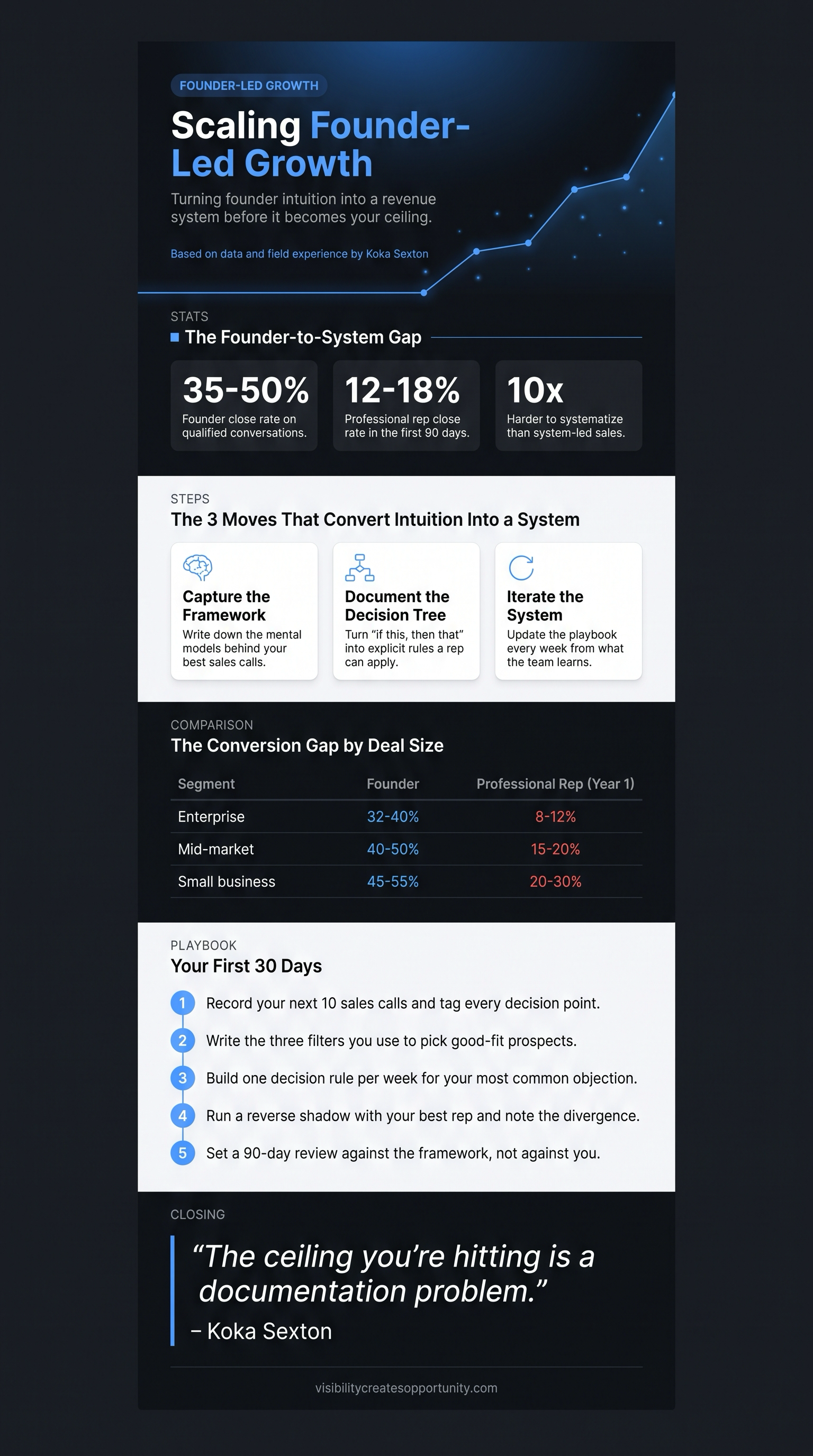
I measure the same thing over and over across the founders I coach. Founders close 35 to 50 percent of qualified conversations. Top hires come in at 12 to 18 percent in the first 90 days. If they're really good, they settle at 20 to 28 percent after six months. That's a structural problem. It's also why founder-led sales feels effortless for the founder and impossible for everyone else. I've never met a founder who escaped this math.
“Your personal conversion rate is the product of accumulated context. Try to scale without documenting that context and your new reps inherit your job title, not your superpower.”
– Koka Sexton
The Founder-to-System Conversion Problem
Scaling beyond founder-market fit takes a fundamental shift. I ask every founder I coach one question first: what did you just decide? You have to turn your intuition into systems. That's harder than it sounds. Most of what you do intuitively, you don't even notice you're doing.
Think about a call where you close. You tailored the narrative after listening for 30 seconds. You skipped the parts of the pitch that wouldn't land. You leaned into an angle that suddenly mattered. You answered an objection by tying it to the vision, not the product. You built urgency without sounding desperate.
A new rep watching you sees someone just talking. They can't see the decision tree underneath. They can't see the rules that make each move right in that moment. So they replicate badly. They follow a script and lose the tailoring, or they improvise and guess at your judgment. The way through is deliberate, documented knowledge transfer. Here are the five steps.
Capture the Framework
Identify the mental models driving your sales conversations: the filters you use to assess fit, prioritize messaging, and read deal momentum.
Document the Decision Tree
Write explicit rules for when to use which approach. If a customer with pain X in stage Y shows behavior Z, prioritize message B.
Build Pattern Recognition
Train reps to spot the pattern before they act. Slow them down enough to apply the framework instead of reacting on instinct.
Establish Feedback Loops
Run weekly reviews of what worked, what did not, and where the rep improvised outside the framework.
Iterate the System
Update the framework from what the reps are learning. Your playbook should evolve with the market, not sit static.
The Conversion Gap by Deal Size
The gap between founder and rep widens as deal size grows. I've mapped it across dozens of companies. It looks like this:
- Enterprise: 8-12% close rate
- Mid-market: 15-20% close rate
- Small business: 20-30% close rate
- Works from a template, so loses tailoring
- Needs the founder for edge cases
- Enterprise: 32-40% close rate
- Mid-market: 40-50% close rate
- Small business: 45-55% close rate
- Improvises around objections in real time
- Handles edge cases from lived context
Notice the pattern. As complexity rises, the founder's advantage multiplies. I see it every time. More context means more to lose in translation. You know exactly why your solution matters to a 500-person financial services company. Your new rep is working from a template. I've seen the gap hit 4x on enterprise deals. That's why the companies that scale don't just hire salespeople. They hire sales leaders who can operate without you, because those people have the judgment to make context-dependent calls alone.
The Dangerous Assumption
Most founders think their early hires just aren't as good at sales as they are. That's the wrong diagnosis. You're judging people on a metric, conversion rate, that depends on context they don't have yet. What matters is how fast a hire can absorb that context. A good rep goes from 15 to 35 percent in nine months when the knowledge transfer is solid. A bad rep sits at 15 percent forever, no matter how much you train them.
Building Founder Intuition Into a System
The real work is systematizing. You convert your intuitive decision-making into documented patterns someone else can apply under pressure. I make every founder I work with write these down. The same discipline governs how you decide which deals deserve your time, the subject of the delegation dilemma.
- Founder knows which objections are real deal-killers vs. noise
- Founder improvises the narrative from the customer profile
- Founder reads deal momentum through subtle signals
- Founder sets price and terms on the fly based on fit
- Founder trusts gut on whether to push or back off
- Objections mapped to risk categories and responses
- Customer segments mapped to message architecture
- Momentum triggers: behaviors that indicate advancement
- Pricing rules based on use case and contract terms
- Written criteria for the push-vs-back-off decision
The left column makes you a great founder. The right column makes your company scalable. The bridge is intentional knowledge transfer, and it isn't comfortable. It forces you to explain decisions you've made on autopilot for years. It forces you to admit some of your best moves came from instinct you can't fully explain. But it's the work that lets you scale. It's also the antidote to the invisible founder tax your calendar has been quietly charging you.
Where the Conversion Drop Actually Happens
The gap hurts most in the closing call. It starts earlier. Founder and rep diverge stage by stage:
- Leads generated: identical for founder and rep, since the top of the funnel is a function of brand and reach, not individual skill.
- Conversations scheduled: roughly 90 percent for both. The rep can book meetings just as well as you can.
- Initial discovery: 75 to 85 percent for both. First calls are mostly information gathering, and a rep handles those competently.
- Advanced conversation: the gap opens. Founders hold 80 percent or more, reps hold 50 to 60 percent. This is where context decides the outcome.
- Deal closed: founders land 35 to 50 percent, reps land 12 to 28 percent. The founder navigates the real concern, not the stated one.
The advanced conversation is where it breaks. That's where the rep has to read the customer's real situation and respond with judgment they haven't built yet. You address the actual concern, not the raised one. You recognize which customers will thrive, and you're not afraid to say no. You hold pricing conviction because you feel the value. None of that is magic. All of it can be taught. It just takes the explicit work of pulling it out of your head and into a system. I check it on every deal review.
Why Better Training Alone Doesn't Work
Most companies try to fix this with a training program. Bring in a consultant. Build a pitch deck. Run monthly sessions. Have reps listen to recorded calls. Six months later, nothing has moved. I've sat in those rooms and watched it.
Why does it fail? Training is passive. It assumes telling someone how to do something equals doing it under pressure. It also assumes the knowledge exists in a form you can present. It doesn't. The knowledge you need to transfer lives in your decisions, your patterns, and the risks you've learned to spot. None of that fits on a slide. Real transfer looks like this:
- Collaborative deal review: walking through live deals together and explaining why you chose each approach.
- Reverse shadow sessions: reps pitch to you and get immediate feedback on where they diverged from the framework and why.
- Systematic iteration: weekly cycles that examine the gap between founder and rep performance and isolate the competencies to develop next.
- Pattern identification: building a shared language for decision-making that previously existed only as instinct.
This takes time. It demands you stay deep in sales while you're trying to leave sales. But it's the only way to build a team that doesn't collapse when you step out of the room.
The Timeline Reality
To get a hire to 80 percent of your conversion rate, plan on 12 to 18 months of intensive knowledge transfer. Not 90 days. Some founders can't accept that. If that's you, hire a Head of Sales instead of a first rep. That person has to operate independently, and they won't wait for you to transfer context.
The Delegation Dilemma
Here's the painful truth. I've watched it cost founders their best hires. At some point, staying deep in sales costs more than the revenue it adds. Once the framework is documented and the team is trained, your presence becomes a luxury. The moment you see that, you've got a new problem. How do you step back without the engine stalling?
The answer is preparation. You don't step back at month one. You step back when four things are true:
- Your team has closed 30 to 40 deals using the framework you documented.
- Your best rep is consistently hitting 30 percent or higher on advanced conversations.
- You have identified which decisions truly require your judgment and which do not.
- You have a data-driven viability score that can stand in for your gut check.
Until then, you're still in the knowledge-transfer business. Once those conditions hold, you move into an advisory role. Review the big deals. Coach the edge cases. Keep iterating the framework from what the market teaches you.
Your First 30 Days
If this sounds like your business, here's my exact sequence for the first 30 days:
- Record your next 10 sales calls and tag every decision point where you deviated from a script. That is your raw material.
- Write the three filters you use to decide whether a prospect is worth your time. Hand them to a rep and see if they can apply them.
- Build one decision rule per week for the objection you hear most often, mapped to the real risk behind it.
- Run a reverse shadow with your best rep and note exactly where their instinct differs from yours.
- Set a 90-day review to compare rep close rates against the framework, not against you.
Frequently Asked Questions
What does it mean to scale founder-led growth?
It means revenue no longer depends on you personally closing every deal. The context, judgment, and story that lived in your head now live in a documented system your team can run, while you keep the vision and the highest-value relationships.
How long does it take to scale beyond founder-led sales?
In the programs I run, it takes 12 to 18 months of deliberate knowledge transfer for a hire to reach about 80 percent of a founder's close rate. It is not a 90-day onboarding. Founders who cannot accept that timeline are usually better served hiring a Head of Sales who can operate independently.
Can a sales hire ever match the founder's close rate?
Yes, with the right context transfer. A strong rep can move from about 15 to 35 percent on advanced conversations in nine months when the framework is documented and reviewed weekly. A weak rep stays near 15 percent no matter how much training you add, so you evaluate the system, not just the person.
What is the founder-to-system conversion problem?
It's the gap between what you do intuitively and what a new hire can replicate. You make dozens of micro-decisions per call without noticing them. Turning that into a system means making the invisible decision tree explicit, so someone else can apply it under pressure.
How many deals do you need to validate a documented sales framework?
I look for 30 to 40 closed deals run through the framework before I trust it. That's enough to separate a framework that works from one that just worked on a few friendly early customers.
What happens if you never systematize founder-led growth?
Your calendar becomes your revenue ceiling. Every month you delay documentation, your pipeline is capped by how many conversations you can carry. And your best hires keep working without the context that makes the model work.
The Window Is Closing
Every month you delay systematizing your sales motion is a month you delay your ability to scale. I've watched founders lose a year to this. The companies that make this transition don't do it by accident. They decide early that intuition is valuable only if it can be documented and transferred.
That means starting sooner than you think. Start the moment you notice your close rate becoming the constraint. At that point you've got a choice. Keep selling yourself and accept that you can only close as many deals as your calendar allows. Or commit to turning what you know into a system someone else can run.
The ceiling you're hitting is a documentation problem.
Build the systems that let your sales scale
The Executive Visibility Program shows you how to document your sales intuition and build a framework that actually transfers to your team. Stop hoping your next hire gets it. Make them guaranteed to.
Book a Strategy Call →