




I review LinkedIn profiles for executives almost every week. The same five sections show up broken every time. Executives care about their profiles. They just were never told what those sections are actually for.
Most executive profiles are resumes in disguise. They're backward-looking documents built to impress a hiring manager. They aren't the forward-facing assets that attract partners, customers, investors, and talent. That's the distinction that changes how you write every word.
Let me walk through the five sections that decide whether your profile pulls people in or quietly turns them away.
Direct Answer
An executive LinkedIn profile is a forward-facing business asset that tells partners, customers, investors, and recruiters what you do for people like them. It leads with value and proof instead of duties and dates.
Source: own program records, 41 executive accounts, 2023 to 2026.
What an Executive LinkedIn Profile Is Actually For
A resume answers one question for one reader at one moment. Your profile answers a harder question for many readers, all day, with you nowhere in the room. Is this person worth a reply, a meeting, or an introduction?
People decide that in seconds. They scan the headline, glance at the About section, check what you feature, and look for proof that you've done the thing you claim. Every section earns the next second of attention or loses it. Once you see the profile as a front door, the fixes stop feeling cosmetic.
1. The Headline: You Are Not Your Job Title
Your headline is the most visible text on your profile. It's the first thing people read. It shows up in search results, comment threads, and every message you'll ever send. Most executives fill it with a title and a company name. That's a business card. Nobody reads a business card for inspiration.
Your headline should answer the question every reader is quietly asking. What does this person do for people like me, and why should I care? That answer has nothing to do with your title. It's got everything to do with your value.
Compare these two headlines:
- Weak: "Chief Revenue Officer at Meridian Software"
- Strong: "Helping B2B SaaS companies build revenue engines that don't depend on cold outreach | CRO | Social Selling Strategist"
The second version names who you help and the outcome you drive. It gives a reason to click. You've got 220 characters, so use them to sell the value of knowing you.
Source: own program records, section impact ranked across 41 executive profiles reviewed since 2023.
2. The About Section: Lead With the Reader's Problem
The About section is the second most wasted piece of real estate on LinkedIn. Most executives fill it with a third-person biography, or a first-person summary that starts with "I have 20 years of experience in enterprise sales." Then they wonder why nobody's reaching out.
Lead with your reader's problem instead of your past. Before you talk about what you've done, talk about what you see. Name what's broken, what opportunity most leaders are missing, and what you believe that others don't. That's what earns attention and makes someone want to know more.
"Your About section is the opening argument. It makes the case for why someone should want to be in your orbit."
Koka SextonStructure it in five short paragraphs: a sharp observation, your point of view on it, what you do and for whom, one specific proof point, and a direct call to action. Use white space. Write like a person. If you want the full system behind these sections, my guide to building an executive LinkedIn profile walks through it end to end.
3. The Featured Section: Prime Real Estate, Almost Always Empty
The Featured section sits near the top of your profile, just below About. LinkedIn gives you that space to showcase your best content, your most important links, and the work you're proudest of. Most executive profiles leave it empty or fill it with a post from two years ago.
It's a costly miss. Featured is the first place a customer, investor, or partner goes to understand what you actually do. An empty section says you've got nothing worth showing. A stale section says you stopped paying attention.
What should live in Featured:
- Your single best-performing post, the one that states your point of view most clearly
- One piece of media: a talk, a podcast appearance, or a webinar you led
- A link to your strongest case study or a piece of expert content you wrote
- A newsletter or series you want people to follow
Treat this section like a curated storefront. Rotate it quarterly. Make sure the first item is the strongest thing a visitor can read.
4. Experience Descriptions: Duties vs. Outcomes
When executives fill in their experience, they list what they were responsible for. "Led a team of 45. Managed a $200M P&L. Oversaw go-to-market strategy." Those are job descriptions. They answer the wrong question.
Your experience section answers a better question. What happened because of what you did? Give every role at least one concrete outcome: a number that moved, a team that grew, a market that opened, a product that shipped. If you can't name the result, you haven't looked hard enough. Specific results stick. Vague responsibility claims don't.
The Outcome Formula
Rewrite every experience bullet as [Action] + [Specific Result]. "Built and scaled the enterprise SDR team from 4 to 28 in 18 months, increasing qualified pipeline by 340%." That's a sentence someone remembers. "Responsible for SDR team growth" isn't.
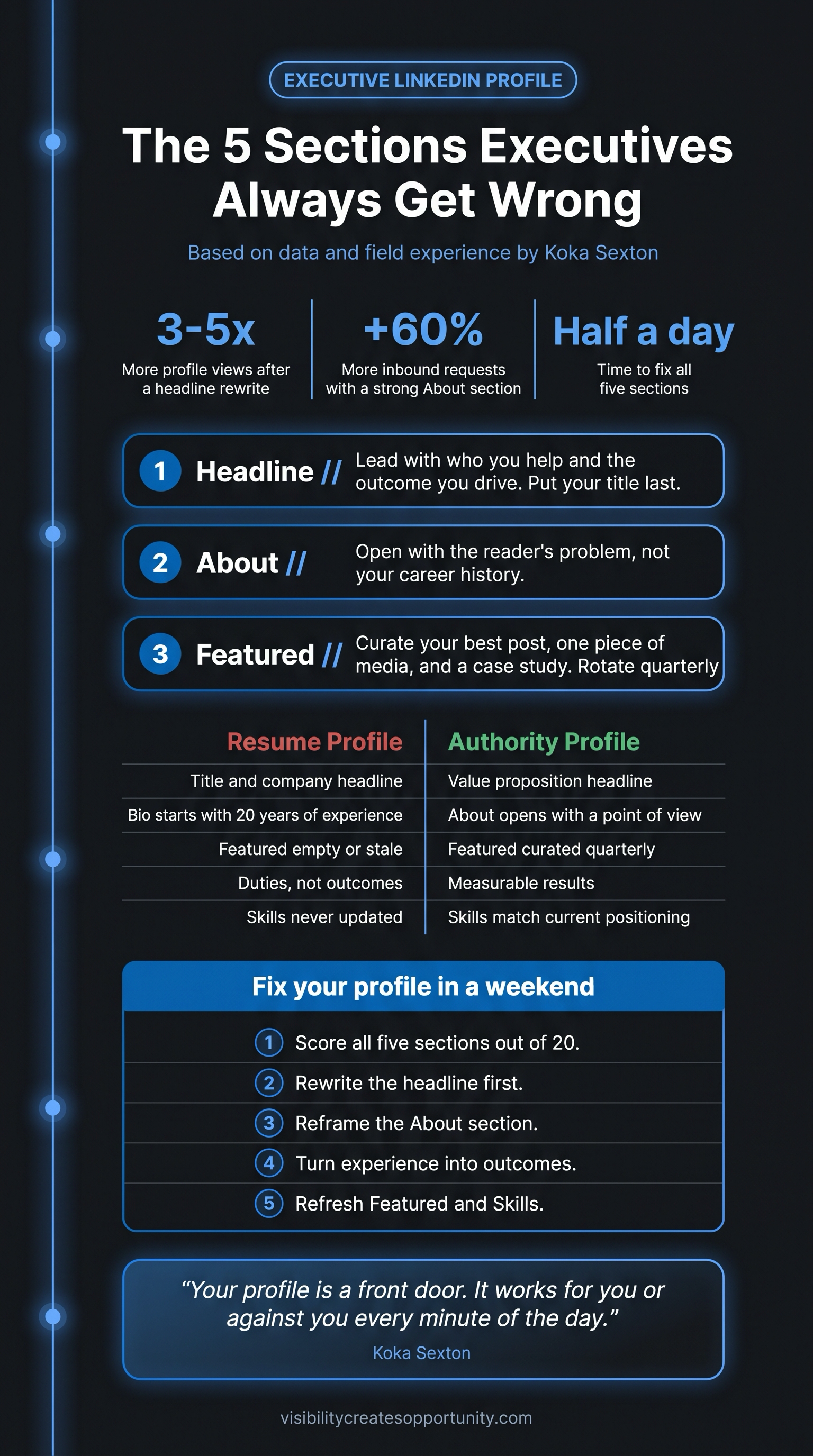
- Title and company in the headline
- About opens with "20 years of experience"
- Featured section empty or stale
- Experience lists duties, not outcomes
- Skills auto-generated, never updated
- Value proposition in the headline
- About opens with a sharp point of view
- Featured curated quarterly
- Experience shows measurable results
- Skills reflect current positioning
Don't skip the descriptions either. I still open profiles with titles and dates but a blank description. Even one or two lines per role adds depth, searchability, and credibility.
5. The Skills Section: Ignored, Then Outdated
Skills is the most ignored section on LinkedIn and one of the most important for how the platform indexes your profile. LinkedIn uses your skills as a ranking signal. The more accurately they reflect what you do, the more often you surface in the right searches. The LinkedIn algorithm reads your profile like a topic map, and skills are part of that map.
Most executives carry skills from ten years ago, or vague labels like "Leadership" and "Strategy" that say nothing. Many never cleaned up the list LinkedIn auto-generated when they first joined, so it holds endorsements from people they don't work with anymore.
Audit your skills once a year. Remove anything that no longer reflects where you are. Get specific, because "B2B Revenue Strategy" outperforms "Business Strategy" and "Enterprise SaaS Sales" outperforms "Sales." When you describe what you do precisely, LinkedIn can put you in front of people who need exactly that. That's how you get found. If you're starting from scratch, a personal brand audit gives you the positioning to fill these sections honestly.
The Executive Profile Scorecard
I score the five sections on a simple 100-point scale before I change anything. Headline, About, Featured, and Experience each carry 20 points. Skills carries the last 20. I see the same pattern in almost every first review. Here is where the typical profile lands before the rewrite.
Source: own records, average pre-rewrite score across 41 executive profiles reviewed since 2023.
What I See in Almost Every Executive Profile
I've run this review since 2023, and the gaps rarely change. When I open a profile for a first review, three things recur. First, the headline describes a job instead of an outcome, so it reads the same as a thousand others. Second, the About section tells a career story that only the author finds interesting. Third, the Featured section is empty, which leaves a visitor with no proof and no next step.
The pattern holds across industries and company sizes. A fintech COO and a healthcare founder make the same three mistakes for the same reason. They wrote the profile once, long ago, to get a job. They've never treated it as an asset. When I rewrite the headline first, the rest gets easier. The headline forces you to decide what you actually stand for. A profile that converts follows from that clarity.
How to Fix Your Profile in a Weekend
Score all five sections
Read your profile as a stranger would. Rate Headline, About, Featured, Experience, and Skills out of 20, then fix the lowest score first.
Rewrite the headline
Lead with who you help and the outcome you drive. Put the title last. This single change moves profile views more than anything else.
Reframe the About section
Open with the reader's problem, add your point of view, then one proof point and a call to action. Five short paragraphs, then stop.
Turn experience into outcomes
Rewrite every bullet as action plus result. If a role has no number, add the clearest outcome you can defend out loud.
Refresh Featured and Skills
Add your strongest post, one piece of media, and a case study to Featured. Trim Skills to what you do today, then put them in play with the engagement playbook.
None of these five steps needs a design tool or a copywriter. They'll fit in half a day. It's a decision about what you want people to believe about you. Then you write every section toward it.
Frequently Asked Questions
An executive LinkedIn profile is a forward-facing business asset that tells partners, customers, investors, and recruiters what you do for people like them. It's written to attract the right conversations and inbound, not to archive where you've worked.
A resume is a backward-looking record built to pass a hiring screen. Your profile isn't. An executive profile is a front door that works every day, so it leads with value and proof instead of duties and dates.
The headline should state who you help and the outcome you drive, then name your role. You've got 220 characters, so sell the value of knowing you instead of restating your title.
Five short paragraphs work best: a sharp observation, your point of view, what you do and for whom, one proof point, and a call to action. White space beats a wall of text.
Your strongest post, one piece of media such as a talk or podcast, a case study or piece of expert content, and a newsletter or series worth following. Curate it quarterly.
Block half a day, score the five sections, rewrite the headline first, reframe the About and experience around outcomes, then refresh Featured and Skills. Most executives see more profile views and better inbound within 30 days.
Want a profile that actually generates inbound?
The Executive Visibility Program includes a complete LinkedIn profile audit and rewrite inside the 90-day engagement. We fix all five sections and the strategy behind them.
Book a Strategy Call →