

AI did something strange to B2B sales. It made the volume of outreach infinite. It also made the quality of most outreach identical.
Every inbox is full. Every buyer is chased by a dozen tools running sequences for companies they've never heard of. The noise has never been louder.
So what cuts through? A person. A recognizable, trusted, visible person with something real to say. Someone a buyer already knows and trusts.
That's why founder-led sales is having a comeback, not a funeral. I've watched it work in my own pipeline and inside dozens of client accounts. The founders who show up win the deals the automations cannot touch.
The numbers below come from the client CRMs I've audited since 2023 and from my own program tracking.
“When every email sounds like a machine wrote it, a human note stops being polite. It becomes priceless.”
What Is Founder-Led Sales?
Founder-led sales is the practice of the founder running the trust-building part of the sales motion in person. Not every deal. The part that needs a human.
The founder publishes a point of view. The founder joins the calls that matter. The founder's reputation does the prospecting that cold outreach used to do.
Key Insight
Founder-led sales works like a distribution channel. It's the founder's visibility that creates demand, and the team converts it.
It's the opposite of hiding behind a logo. When a buyer can see the person behind the product, the sales cycle shrinks. I've watched this hold from pre-seed to Series C. I lay out the full model in my pillar on founder-led growth.
The Trust Scarcity Premium
When the supply of something rises, its value falls. AI has flooded the market with outreach. It can't flood the market with trust.
Genuine authority is still scarce. A founder who's shared real perspective for months owns something no tool can copy. Earned trust.
That trust changes the first call. A cold meeting starts at zero. A meeting booked after months of reading your posts starts warm. The close rates aren't close.
Trust also shortens the cycle. I closed one deal in nine days because the buyer had followed my work for a year. The first call felt like the third.
“AI raised the floor on outreach noise. That raised the ceiling on human authority.”
What Founder-Led Selling Looks Like at Scale
Founders tell me they can't scale themselves. They think founder-led means closing every deal alone. It doesn't.
At scale, the founder's visibility sets the conditions. Content creates awareness. Expertise creates credibility. Visible proof attracts inbound.
I wrote a post in 2024 that still brings replies today. The content keeps working after I stop touching it. That's the entire point.
The Three Unfair Advantages Founders Have
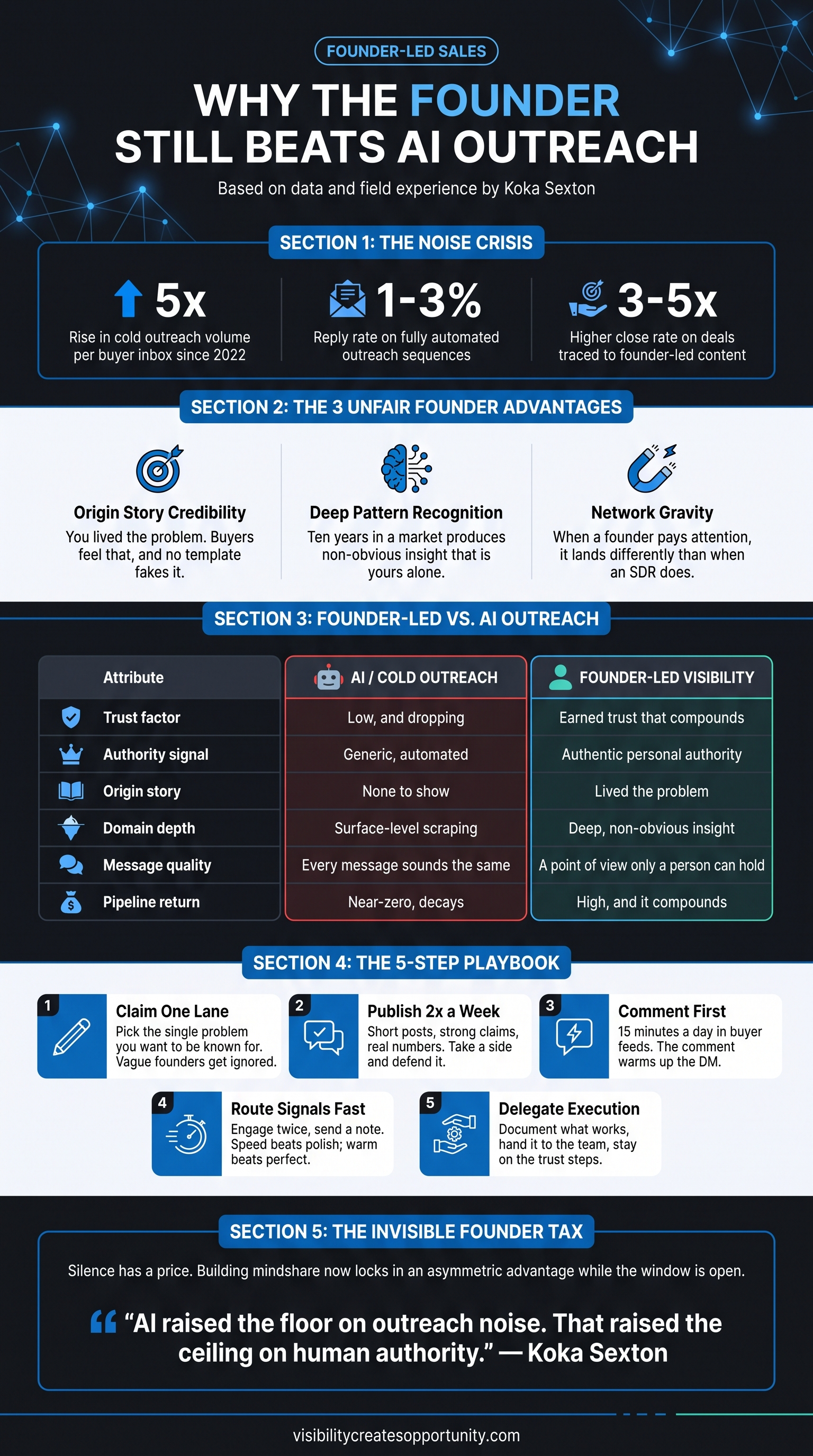
Founders hold three advantages no SDR, agency, or AI tool can copy.
- Origin story credibility. You lived the problem. Buyers feel that, and no template fakes it.
- Pattern recognition at depth. Ten years in a market produces non-obvious insight. That insight is yours alone.
- Network gravity. When a founder pays attention, it lands differently than when an SDR does. That signal opens doors.
- Infinite volume, low trust
- Generic authority signals
- No origin story credibility
- Surface-level domain insight
- Every message sounds the same
- Earned trust that compounds
- Authentic personal authority
- Lived origin story
- Deep, non-obvious pattern recognition
- Network gravity at every level
Why Most Founders Still Sit It Out
Three excuses come up every time I ask a founder why they're invisible. No time. Nothing to say. No proof it works. All three are solvable.
Key Insight
The founders who claim they have nothing to say usually have the most. What's missing is a system for capturing that insight. It's a process problem, not a content problem.
The time excuse is weak. Two short posts a week take less time than setting up one cold email sequence. The return is not a contest.
The belief excuse is the hard one. It usually breaks the first time a buyer opens with, I have been following your work for months. After that, no one asks me whether this works.
How to Run Founder-Led Sales: 5 Steps
Here's the system I run with founders. It takes about 30 minutes a day.
Claim one lane
Pick the single problem you want to be known for. Vague founders get ignored. Sharp ones get remembered.
Publish a point of view twice a week
Short posts. Strong claims. Real numbers. Don't report. Take a side and defend it.
Comment before you pitch
Spend 15 minutes a day in your buyers' feeds. The comment is the warm-up that makes the DM easy. I built my whole engagement flywheel on this one habit.
Route signals into a conversation
When someone engages twice, send a note. Speed matters more than polish. Warm beats perfect every time.
Hand off the motion
Document what works and let the team run it. Keep the founder on the trust steps. When this gets heavy, follow the scaling playbook.
Founder-Led Sales vs. AI Outreach
Compare the two motions on the same time budget. The gap is not small.
The Cost of Staying Invisible
Silence has a price. I have quantified it for clients, and it runs higher than most founders expect. The deals you never see are the expensive part. No buyer calls to tell you they chose a competitor because they recognized that founder and not you.
That gap is the invisible founder tax. It's real, and it compounds against you every silent month. I break down the full math in The Cost of Founder Invisibility.
Why the Window Is Open Right Now
Very few executives are consistently visible on LinkedIn. The ones who build real authority in the next year will own mindshare in their category.
AI raised the floor on outreach noise. That raised the ceiling on human authority. Founder-led sales still returns more than any motion available. It's the highest-return move open to any executive who understands where trust comes from.
Frequently Asked Questions
What is founder-led sales?
Founder-led sales is the practice of the founder running the trust-building part of the sales motion in person. The founder publishes a point of view, joins the calls that matter, and lets their reputation do the prospecting.
Why does founder-led sales still work when AI can automate outreach?
AI increased the supply of outreach, not the supply of trust. Genuine authority is still scarce. A meeting booked after months of reading a founder's work starts warm, so close rates run far higher than on cold sequences.
When should a founder stop doing sales themselves?
Hand off the repetitive parts early. Keep the trust steps: the point of view, the origin story, the calls where credibility decides the deal. Document the rest so a team can run it.
How much time does founder-led selling actually take?
About 30 minutes a day. Two short posts a week, 15 minutes of commenting, and a fast reply when a warm signal shows up. That's less time than setting up one cold email sequence.
Does founder-led sales work for B2B SaaS?
Yes. Trust matters most when the buyer is betting on a person as much as a product. Early-stage B2B SaaS is where founder-led selling has the largest advantage, because the founder is the only credible voice the company has.
How do you measure founder-led sales?
Track warm signals, not vanity metrics. Count inbound conversations that started from content or comments, the close rate on those deals, and the time from first touch to first call. Pipeline sourced this way is the number that matters.
Build the authority that closes deals before they start
The Executive Visibility Program is built for founders who want their LinkedIn presence to generate real business outcomes, not just impressions.
Book a Strategy Call →